 Skip to content

GMC C0051 — Steering Wheel Position Sensor Fault & Fix
Direct answer: The GMC C0051 code means the steering wheel position sensor (steering angle) is reporting a value that’s out of range or implausible. Fixing it requires a proper scan, checking wiring/connectors and steering angle sensor, and most often an ADAS/steering-angle calibration or sensor replacement followed by a calibration so the vehicle’s safety systems can function correctly.
Key Takeaways
- GMC C0051 = Steering Wheel Position Sensor fault (angle signal out of range or implausible).
- Common causes: sensor drift, collision/bump, battery disconnect, poor connector or clock spring issue.
- Diagnosis order: full scan, inspect connectors and wiring, check steering angle sensor and clock spring, confirm vehicle alignment, then re-calibrate.
- The typical fix is sensor recalibration or replacement plus ADAS calibration — don’t ignore it; it affects stability and airbag/ADAS functions.
What GMC C0051 Actually Means
The scanner definition for C0051 is simple: the steering wheel position sensor (also called the steering angle sensor, SAS) is reporting a value that the module considers out of range or implausible. That means the electronic control module receiving the steering angle data sees numbers that don’t make sense for the current driving or steering position.
LockNCal runs dealer-level diagnostics at your location across Dallas–Fort Worth. On-site: $0 today, pay after the job. Book mobile diagnostics or call (469) 277-7277.
Why this matters — safety and driving systems affected
The steering angle is a primary input for several vehicle safety systems: electronic stability control (ESC), traction control, anti-lock brakes (ABS), lane keeping systems and some airbag logic. If the steering angle is wrong, those systems may be disabled, perform poorly, or cause warning lights and fault codes. That’s why C0051 should be diagnosed and corrected rather than ignored.
Common causes of C0051
- Steering angle sensor drift or failure — internal sensor electronics can fail or move out of calibration.
- Clock spring or steering column damage — a damaged clock spring can interrupt signals to/from the steering wheel area.
- Battery disconnection or recent steering or suspension work — can require re-zeroing the steering angle.
- Connector corrosion, wiring damage, or poor ground/battery voltage.
- After a collision or impact — mechanical changes can shift sensor position or damage wiring.
Symptoms drivers may notice
- Steering or stability warning lights (ESC, Traction Control, ABS) or an illuminated airbag/SRS light.
- Lane-keeping or adaptive cruise features behaving erratically or turning off.
- Electronic stability control intervening unexpectedly or not engaging when it should.
- Possible steering feel changes if the EPS uses angle input for assist logic (less common).
- No obvious symptom other than the DTC visible on a scan tool.
How a technician should diagnose C0051 — step-by-step
Diagnosing C0051 is about ordering checks to separate sensor failure from a wiring, connector, mechanical or calibration issue. Here’s the practical tech workflow:
- Connect a professional scan tool and confirm the exact definition and freeze frame data for C0051. Record stored codes and timestamps.
- Read live steering angle data while turning the wheel slowly from lock-to-lock. Compare the readings to the steering wheel position. Look for erratic jumps, locked/flat values, or impossible readings.
- Check for related codes (ABS, ESC, airbag, communication faults). Multiple systems reporting steering angle problems points to a shared wiring, connector or clock spring issue.
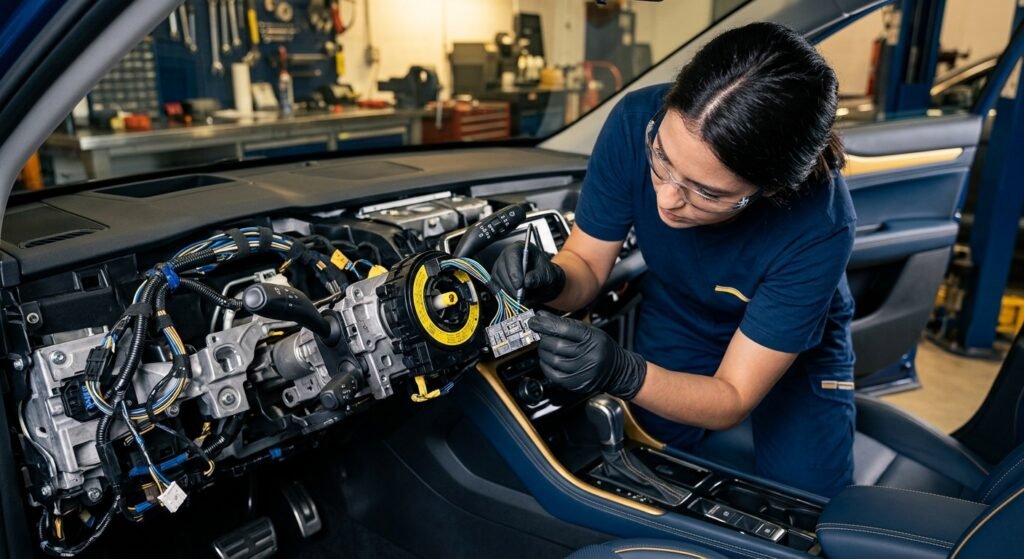
- Visually inspect the steering column area, clock spring, connector pins, and wiring harness for damage, corrosion or loose connectors. Also check ground points and battery voltage stability.
- If a recent battery disconnect, wheel alignment, suspension/steering service, or collision occurred, note it — most modern systems need a steering angle zero/centering procedure after work.
- If wiring and connectors are good, test or replace the steering angle sensor where applicable. Some vehicles integrate the sensor into the EPS or ABS module; others have a discrete module.
- After repair or replacement, perform a steering angle zero/calibration and a full ADAS calibration where required (camera/lidar/radar-related ADAS systems often need recalibration after angle errors).
- Clear codes, road test with live data monitoring, and confirm the code does not return and that stability/ADAS systems behave correctly.
Quick diagnostic checklist
| Check | What to look for | Next step |
|---|---|---|
| Scan for codes | Confirm C0051 and related faults | Note freeze frame and live data |
| Live steering angle data | Erratic or impossible values | Inspect sensor/clock spring/wiring |
| Physical inspection | Damaged connectors, clock spring wear | Repair connector or replace clock spring if needed |
| After replacement | Sensor or clock spring swapped | Perform steering angle zero and ADAS calibration |
When is it safe or unsafe to drive?
Short answer: it depends on which systems are affected. If C0051 only triggers a logged code but stability control, ABS and airbags are still reporting normal status, short trips to a shop may be acceptable. But if stability control or airbag warnings are active, or if ADAS features like lane keep or automatic braking are disabled, you should avoid highway speeds and get the vehicle inspected promptly.
Practical guidance
- If the SRS/Airbag light is on along with C0051, treat it as a priority — safety restraints and airbag logic can be impacted.
- If ESC/ABS lights are on, avoid aggressive driving or slippery conditions until fixed.
- Document when the code appeared (after a collision, battery replacement, etc.) and share that with the technician — it speeds diagnosis.
Correct fixes — what actually solves GMC C0051
There is no single universal fix because the root cause varies. The correct resolution is one of these actions, depending on diagnosis:
- Steering angle sensor calibration (zeroing) when the sensor has simply lost its reference after a battery disconnect or service.
- Replacement of a faulty steering angle sensor or clock spring if diagnostics show hardware failure or intermittent signal loss.
- Repair of wiring or connector faults if corrosion or damage is found.
- Follow-up ADAS calibrations for systems that rely on accurate steering angle data (cameras, radars, lane-keeping).
Because steering angle feeds multiple safety systems, the professional fix usually includes a proper calibration step so ESC/ABS and ADAS modules share a consistent steering reference.
Why ADAS calibration is often the final and necessary step
After sensor replacement or any steering/suspension work that affects wheel alignment or steering geometry, ADAS systems that rely on camera or radar tracking need recalibration so lane-keeping, automatic emergency braking, and adaptive cruise operate correctly. That’s why the service that resolves C0051 frequently routes to an ADAS calibration specialist.
For scheduling and details about mobile calibration and related services, see LockNCal’s ADAS calibration information and our on-site service options: ADAS calibration and on-site mobile services.
How long does diagnosis and fix usually take?
Diagnosis time varies: a quick scan and live-data check can take 20–30 minutes. A wiring or connector fix may be done in an hour or two. If the steering angle sensor or clock spring needs replacement and then ADAS calibration is required, plan for a half-day to a full-day appointment depending on the vehicle and which calibrations are necessary.
When another shop’s “repair” claim should raise questions
You’ll sometimes see low-cost “steering angle repair kits” or cheap fixes promoted online. Be cautious: cheap or non-OEM sensor fixes that don’t follow manufacturer calibration procedures can leave your ESC, ABS or ADAS systems unreliable. If a shop describes changing a sensor without performing the correct calibration and verification steps, ask for the calibration procedure and test data before you accept the work.
FAQ
Q: What causes GMC C0051?
A: C0051 is caused by the steering angle sensor reporting out-of-range or implausible values. Causes include sensor failure, clock spring or wiring damage, battery disconnects, or changes after a collision or suspension work.
Q: Can I clear the code myself?
A: You can clear the code with a scan tool, but if the underlying issue remains (bad sensor, wiring, or missing calibration) the code will likely return. Proper diagnosis and calibration or replacement is required to fix it for good.
Q: Will C0051 affect my airbags or safety systems?
A: Yes. Steering angle feeds ESC, ABS and some airbag/ADAS logic. If associated warning lights are active, have the vehicle inspected promptly to ensure safety systems work correctly.
Q: Is this an ADAS calibration job?
A: Often it is. Many C0051 cases are resolved by a steering angle zero and ADAS calibration after sensor replacement or steering/suspension work. A qualified calibration process ensures lane-keeping and automatic braking systems function correctly.
Q: How soon should I get this fixed?
A: Get it diagnosed as soon as practical. If airbag or stability warnings are active, avoid high-speed or slippery driving and have the vehicle checked immediately.
Next steps
If you see GMC C0051 on your dash or scan report, have a technician perform a live-data steering angle check and a careful wiring/clock spring inspection. If the diagnostics point to recalibration or replacement, an ADAS calibration is often the required final step to restore vehicle safety systems.
To schedule professional ADAS calibration or mobile diagnostic help, visit our appointment page and call (469) 277-7277.


