 Skip to content

Direct answer: The Chevrolet P0420 code means “Catalyst System Efficiency Below Threshold (Bank 1).” It indicates the catalytic converter or related sensors are not meeting efficiency expectations. Fixes range from diagnosing and repairing exhaust leaks or engine misfires to replacing a failed catalytic converter or oxygen sensors after proper testing.
Key Takeaways
- P0420 = Catalyst System Efficiency Below Threshold (Bank 1), a downstream emissions/performance fault.
- Common causes: failed catalytic converter, bad downstream O2 sensor, exhaust leak, or persistent misfire/lean condition.
- Diagnosis is data-first: read freeze-frame, monitor upstream/downstream O2 sensors, fuel trims, and search for related codes.
- Repair often means replacing the catalytic converter or oxygen sensors — confirm with tests before replacing parts.
- If you only have a P0420 and the car drives fine, short-term driving is usually possible but emissions may fail; prioritize a proper scan and diagnosis.
What the code actually means
The factory definition for P0420 is “Catalyst System Efficiency Below Threshold (Bank 1).” That means the vehicle’s powertrain control module (PCM) has detected that the catalytic converter on Bank 1 is not reducing emissions as expected. The PCM compares the upstream oxygen sensor behavior (pre-catalyst) to the downstream oxygen sensor (post-catalyst). When the downstream sensor looks too similar to the upstream sensor, the PCM concludes the catalyst isn’t doing its job.
Common causes
- Catalytic converter failure or clogging (age, contamination, or physical damage).
- Faulty downstream oxygen sensor (Bank 1 Sensor 2) giving incorrect readings.
- Exhaust leaks upstream of the downstream O2 sensor or near the catalytic converter.
- Long-term engine problems causing unburned fuel or contamination: misfires, oil or coolant burning, or rich/lean conditions.
- Wiring or connector problems on the O2 sensors or PCM side.
- Aftermarket exhaust components or incorrect replacement parts that change flow/efficiency.
Symptoms you may notice
- Check Engine Light (CEL) illuminated — often steady for P0420.
- Failed emissions test or inspection.
- Reduced fuel economy in some cases, or a rotten-egg (sulfur) smell if the converter is contaminated.
- Rough idle, hesitation, or drivability problems only if an underlying misfire or fuel-trim issue is present.
- Abnormal exhaust noise if there’s a leak or physical damage.
Tools you’ll need for diagnosis
- Full-feature OBD-II scan tool with live-data and freeze-frame (preferably bi-directional).
- Multimeter for sensor and wiring checks.
- Infrared thermometer or thermocouples to check converter temperature top & bottom.
- Exhaust backpressure gauge or vacuum gauge for flow tests.
- Smoke machine to find exhaust leaks.
- Optional: wideband O2 sensor or lab-grade analyzer for precise readings.
Step-by-step technician diagnosis (recommended order)
- Confirm the code and capture freeze-frame data. Record the conditions (temp, RPM, load) when the code set.
- Scan for related codes. Look for misfire codes (P01xx/P03xx), fuel system codes, or O2 sensor heater faults (P013x/P015x) — these often cause or mask catalyst issues.
- Inspect visually. Check exhaust piping, clamps, and hangers for leaks or damage near the manifold, catalytic converter, and sensor locations.
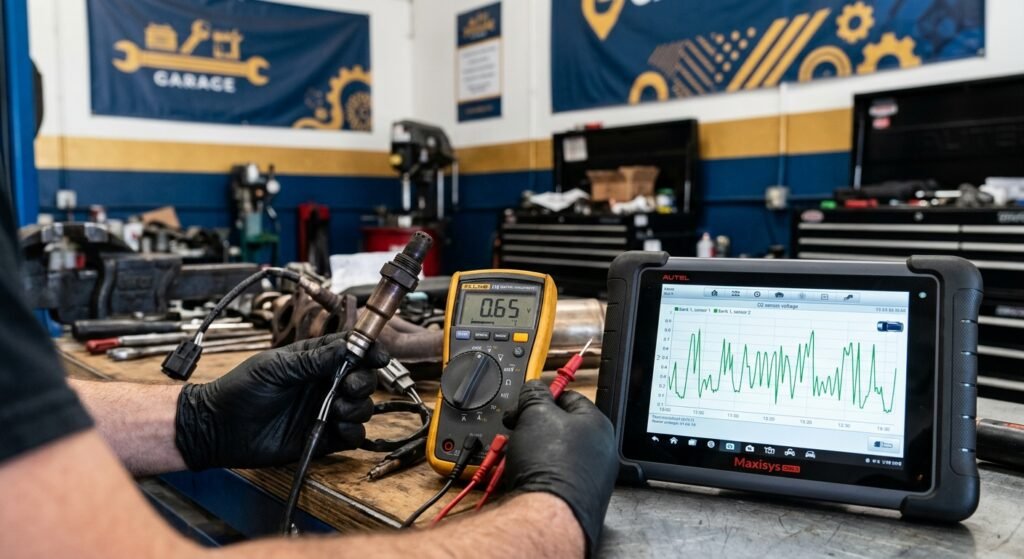
- Check O2 sensor operation. With the engine warm, monitor Bank 1 Sensor 1 (upstream) vs Bank 1 Sensor 2 (downstream). Upstream should switch frequently; downstream should be relatively steady if the catalyst is working.
- Use temperature checks. Measure converter inlet vs outlet temps—an efficient converter will typically be hotter downstream than upstream under load.
- Check fuel trims and misfire counters. Excessive long-term fuel trim, or active misfires, point to combustion problems that can damage the catalyst.
- Look for exhaust leaks. Use a smoke test or listen for leaks; even small leaks upstream of the downstream sensor can falsely trigger P0420.
- Test O2 sensor wiring and heater circuit. Verify connectors, continuity, and heater resistance with a multimeter; bad wiring can mimic sensor failure.
- Backpressure or flow testing. If data points to a clogged converter, check exhaust backpressure or use a vacuum gauge to confirm restricted flow.
- Confirm with a sensor swap or wideband test. If the downstream sensor looks suspicious, swapping a known-good sensor (or testing with a wideband) can validate whether the sensor or cage is at fault.
Quick diagnostic table
| Probable Cause | What to Check | Likely Next Step |
|---|---|---|
| Bad catalytic converter | Downstream O2 follows upstream; higher inlet/outlet temp; high backpressure | Confirm with temperature/backpressure tests; replace converter if failed |
| Faulty downstream O2 sensor | Heater fault codes, slow or stuck downstream readings | Test wiring/heater; replace sensor and re-check |
| Exhaust leak | Audible leak, smoke test positive, inconsistent downstream readings | Repair leak, then clear codes and re-evaluate |
| Engine misfire / fuel issues | Misfire codes, poor fuel trims, oil/coolant consumption | Fix misfire/fuel problem (plugs, injectors, compression), then retest |
What fixing P0420 usually involves
There is no single one-size-fits-all cure. After proper diagnosis you may need to:
- Replace a failed catalytic converter (common when tests confirm reduced efficiency).
- Replace the downstream oxygen sensor (Bank 1 Sensor 2) if it’s faulty or slow.
- Repair exhaust leaks, sensor wiring, or connectors that are producing false readings.
- Address underlying engine issues (misfires, fuel trim problems or oil/coolant burning) that damage the converter over time.
Do not replace the catalytic converter or sensors without confirming the root cause. Replacing parts on a data-poor diagnosis risks wasting money and leaving the true issue unresolved.
When is it safe or unsafe to drive?
If P0420 is the only code and the car runs normally (no misfires, no overheating, no strong smells), short-term driving is usually safe — but you may fail an emissions test. If you notice misfires, a strong sulfur smell, overheating, or significant performance loss, avoid extended driving and get a proper diagnosis. Persistent misfires can overheat and irreversibly damage a catalytic converter.
Cost considerations and emissions testing
Costs vary widely by vehicle and region. Catalytic converters are one of the more expensive emission-control components; oxygen sensors are cheaper but still worth testing before replacement. If you’re buying a used Chevrolet with a P0420, consider a professional inspection — the fault could be a simple sensor or indicate an expensive converter replacement.
Next steps: what to tell your mechanic
When you bring the vehicle in, give your technician these items to speed diagnosis:
- When the light first appeared and any driving conditions at the time (cold start, highway, towing).
- Any recent work on the exhaust, engine, or sensors.
- Results from any DIY checks you ran (freeze-frame data, upstream/downstream graphs, temperature readings).
- Permission for the tech to run live-data sessions, exhaust pressure tests, and smoke checks if needed.
If you’re evaluating a used vehicle with a P0420, a professional pre-purchase inspection can quantify how serious the issue is; see the pre-purchase vehicle inspection for what a thorough check includes.
One note about safety and LockNCal
This code is an emissions/engine issue and not a service LockNCal performs. If you ever need help with your vehicle’s safety and security systems — airbag/SRS module resets, ADAS calibration, or keys — we handle those services; see our vehicle safety system services for details.
FAQ
Q: Will clearing the P0420 code make the Check Engine Light stay off?
A: Clearing the code will turn the light off temporarily, but if the underlying problem remains the code will return. Diagnose first before clearing codes.
Q: Can a bad O2 sensor cause P0420?
A: Yes. A faulty or slow downstream O2 sensor (Bank 1 Sensor 2) can mimic a catalytic converter failure and trigger P0420. Test the sensor and wiring before replacing the converter.
Q: Will a P0420 cause my car to stop running?
A: P0420 is usually not immediately catastrophic — it’s an emissions efficiency fault. However, if it’s caused by ongoing misfires or engine issues, those underlying problems can lead to drivability problems and should be addressed promptly.
Q: I failed emissions. Do I always need a new catalytic converter?
A: Not always. Exhaust leaks, bad oxygen sensors, or engine problems can cause a failed emissions test. Proper diagnostics can often pinpoint a cheaper fix than a full converter replacement.
Q: Is P0420 covered under warranty?
A: Coverage depends on vehicle age, mileage, and warranty details (emission control warranties vary). Check your warranty paperwork or consult a dealer to confirm coverage.
If you want a professional inspection to understand how serious a P0420 is on a used Chevrolet, consider scheduling a pre-purchase or diagnostic appointment and call (469) 277-7277 for help arranging a time.


