 Skip to content

Direct answer: The Jeep P0301 code means exactly this: Cylinder 1 Misfire Detected. It signals a repeated misfire in cylinder 1 and can be caused by ignition, fuel, mechanical, or wiring problems. Diagnose with a good OBD-II scanner, look at misfire counters and live data, then test ignition, fuel injection, compression, and wiring in that order.
Key Takeaways
- P0301 Jeep = Cylinder 1 Misfire Detected.
- Common causes: bad spark plug, failed coil, clogged injector, low compression, or wiring/ECM issues.
- Start diagnosis with a quality scan tool and live-data misfire counters, then test coils, plugs, injectors, and compression.
- Driving on a persistent misfire risks catalytic converter damage and unsafe operation—get it checked promptly.
What “Cylinder 1 Misfire Detected” means
The verified meaning for DTC P0301 is: “Cylinder 1 Misfire Detected.” For Jeep owners (Wrangler, Grand Cherokee, Cherokee and others) this means the engine control module (ECM) has logged multiple misfire events originating from cylinder number 1. A misfire means that cylinder isn’t producing full combustion when commanded, so it’s not contributing proper power and it’s throwing unburned fuel into the exhaust.
Why this matters
Even one misfiring cylinder can cause rough idle, loss of power, and increased emissions. Continued driving with a misfire can overheat and damage the catalytic converter, cause poor fuel economy, and make the vehicle unsafe to drive if drivability worsens (stalling, severe shaking).
Common causes of P0301 (jeep code p0301)
Here are the most common root causes for a P0301 Jeep code, listed from most likely to least likely for modern Jeeps:
- Faulty spark plug in cylinder 1
- Bad or intermittent ignition coil (coil-on-plug) for cylinder 1
- Clogged or failed fuel injector on cylinder 1
- Low compression in cylinder 1 (worn rings, burned valve, head gasket leak)
- Vacuum leak or intake manifold leak affecting cylinder 1 port
- Wiring/connectors to coil or injector damaged or corroded
- ECM/software or module communication problems (less common)
Quick cause/reference table
| Cause | How it shows | Quick in-shop test |
|---|---|---|
| Bad spark plug | Rough idle, visible fouling or gap issues | Remove plug, inspect tip, swap with another cylinder and see if code follows |
| Failed ignition coil | Misfire counter spikes for cylinder 1, no spark on plug | Swap coil with another cylinder (if practical) to see if misfire moves |
| Clogged injector | Cylinder lean or intermittent misfire, poor fuel economy | Listen with stethoscope, swap injector, or bench-test injector |
| Low compression | Persistent misfire, oil consumption, white smoke | Compression or leak-down test |
| Wiring/connector problem | Intermittent misfires or codes after vibration/water exposure | Inspect harness, wiggle-test, check continuity/voltage |
Symptoms drivers report (jeep dtc p0301 / p0301 jeep)
- Rough idle or shaking at stop lights
- Loss of power under acceleration
- Illuminated Check Engine Light with code P0301
- Reduced fuel economy and black smoke or smell of unburned fuel
- Possible hesitation or stalling at low RPM
Step-by-step diagnostic checklist (technician order)
Use this order to avoid wasted parts swapping. Commonly the issue is ignition or plugs, so start there.
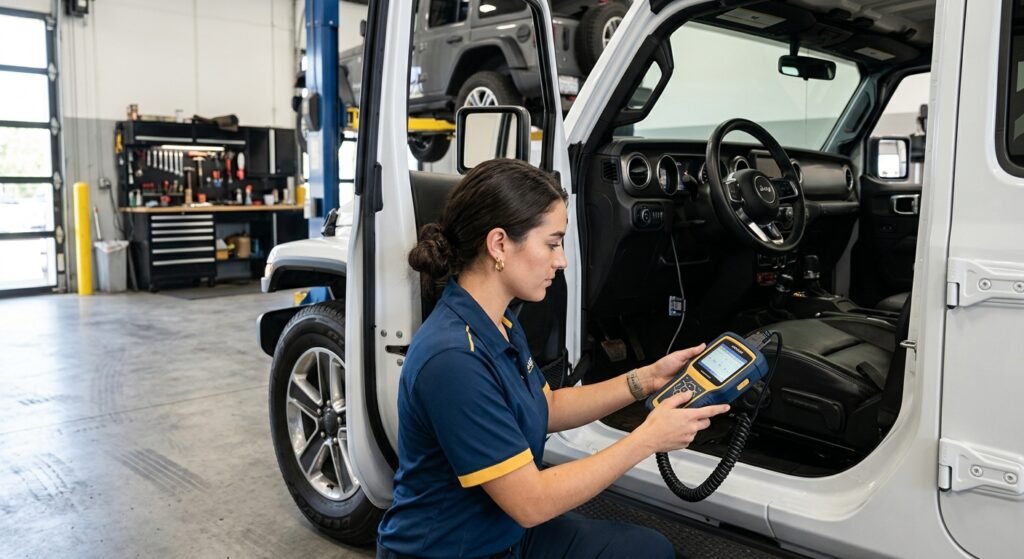
- Scan tool & live data: Use an OBD-II scanner that shows cylinder misfire counters, fuel trims, and live RPM. Confirm P0301 is current (pending vs confirmed). Watch the misfire counter for cylinder 1 while revving and idling.
- Freeze frame & pending codes: Save freeze frame data to know engine load and temperature when the code set.
- Visual inspection: Check coil-on-plug boot, connector, and spark plug well for oil or coolant. Look for cracked boots or corrosion.
- Spark check: Remove the spark plug from cylinder 1 and inspect. Look for fouling, oil, deposits, or incorrect gap. Use a spark tester or scope to verify coil output.
- Coil swap test: If the vehicle uses individual coils, swap cylinder 1 coil with another cylinder’s coil. Re-scan; if the misfire follows the coil, the coil is bad.
- Injector test: Listen to the injector with a mechanic’s stethoscope for an audible click. Check injector resistance with a multimeter and compare to spec, or carefully swap injectors if practical to see if misfire moves.
- Fuel pressure and supply: Verify fuel pressure and rail integrity. A weak pump or clogged filter can cause intermittent misfires.
- Compression / leak-down test: If ignition and fuel seem fine, measure compression on cylinder 1 and compare with other cylinders. Low compression indicates internal mechanical issues (rings, valves, head gasket).
- Vacuum/intake leak check: Spray a safe starter-fluid or use propane around the intake gasket/port for cylinder 1 while watching engine RPM—if RPM changes, you have a leak.
- Wiring and PCM checks: Inspect harness for chafing or corrosion. Check injector and coil voltages with a multimeter. If wiring is intact and grounds are good, consider module/ECM diagnosis at a shop with scope and manufacturer tech info.
When is it safe or unsafe to drive?
Short answer: brief driving at reduced speed to a repair shop is usually okay, but avoid long trips or highway speeds if the misfire is severe. If you smell raw fuel, see black smoke, the engine stalls, or the vehicle surges, stop driving: those signs increase the risk of catalytic converter damage, fire hazard, and a sudden loss of power.
Correct fixes (what a mechanic will actually do)
- Replace worn or fouled spark plug in cylinder 1.
- Replace failed ignition coil (or coil-on-plug) for cylinder 1.
- Clean, service, or replace a clogged/failed fuel injector.
- Repair intake manifold gasket or vacuum leak affecting cylinder 1 port.
- Address mechanical causes: cylinder head work, valve service, or replace head gasket for low-compression failures.
- Repair or replace damaged wiring/connectors to coils or injectors, or reprogram/replace module if confirmed faulty.
These are shop-level jobs. If a simple part swap (plug or coil) fixes it, many independent shops can handle it quickly; deeper mechanical fixes like head gaskets or valve work require more time and specialist equipment.
Model notes: Wrangler, Grand Cherokee, Cherokee
Owners often search “p0301 jeep grand cherokee” or “p0301 code jeep wrangler” because these models share common ignition coil and injector layouts that make coil or plug failures frequent. The diagnostic approach is the same across these models: verify the misfire with live data, then use coil-swap and compression checks to isolate the root cause.
Costs and parts
Costs vary widely by region and the specific fix. Avoid blind parts swapping—diagnose first. If you do swap a suspected coil or plug yourself, keep the old part for exchange and testing. For trusted inspection before purchase, consider a professional pre-purchase vehicle inspection to catch intermittent misfires early: mobile pre-purchase vehicle inspection.
Practical tips for DIYers
- Always record the exact code(s) and freeze-frame data before clearing codes.
- If swapping coils/plugs, make sure the engine is cool and follow torque specs from a reliable manual.
- Use an OBD-II scanner that reports cylinder-level misfire counts and freeze-frame data—cheap scanners often miss useful live info.
- Keep track of whether the misfire is constant or intermittent—intermittent faults often point to wiring or injector problems over worn mechanical parts.
Where to go next
Because P0301 is an engine/drivetrain code, the correct next step is a full diagnostic at a trusted mechanic or shop with the right tools (scan tool with misfire counters, compression tester, fuel pressure gauge, oscilloscope). If you want to confirm vehicle safety systems are unaffected (airbags, SRS, ADAS) after any incident, LockNCal handles vehicle safety and security systems like SRS airbag module reset and ADAS calibration; see our vehicle safety system services for details.
FAQ
A: P0301 means “Cylinder 1 Misfire Detected.” It’s a misfire code specific to cylinder 1 on Jeep vehicles.
Q: Can I clear P0301 and keep driving?
A: Clearing the code may temporarily turn off the Check Engine Light, but it won’t fix the underlying issue. If the misfire returns, don’t ignore it—driving long-term can damage the catalytic converter and create unsafe conditions.
Q: Is P0301 common on Jeep Grand Cherokee or Wrangler?
A: Yes, owners of Jeep Grand Cherokee, Wrangler, and Cherokee commonly report P0301 due to worn plugs or coils. The diagnostic approach is the same across models.
Q: Will replacing the ignition coil fix P0301?
A: If the coil is the fault, replacing it will usually stop the misfire. But always confirm with live-data and a coil-swap test before replacing parts.
Q: Could a vacuum leak cause P0301?
A: Yes. An intake or vacuum leak that affects cylinder 1 can cause a lean misfire and set P0301; test by spraying a safe aerosol or propane around the intake while watching RPM.
For a thorough diagnostic and fast, reliable service, schedule an appointment online at https://lockncal.com/schedule-your-service-appointment/ or call (469) 277-7277.


