 Skip to content

Mitsubishi U0140 — Lost BCM Communication: Causes & Fix
Direct answer: The Mitsubishi U0140 code means “Lost Communication With Body Control Module (BCM).” It usually indicates the vehicle’s network can’t talk to the BCM because of a wiring/connection issue, a missing or programmed BCM, or a failed module. The correct fix is systematic diagnostics and, if needed, module reprogramming or replacement performed by a trained technician.
LockNCal does mobile module programming and diagnostics across Dallas–Fort Worth. On-site: $0 today, pay after the job. Book mobile module programming or call (469) 277-7277.
Key Takeaways
- U0140 = Lost communication with the Body Control Module (BCM).
- Common causes: blown fuse, bad ground, wiring/connectors, CAN bus fault, aftermarket interference, or a dead/unprogrammed BCM.
- Diagnosis order: confirm code, check battery/fuses, scan for other network codes, test CAN bus and BCM presence, inspect for aftermarket gear.
- Typical results: reprogram the BCM, fix wiring/grounds, or replace and program a new BCM.
- If unsure, get a full module diagnostic — driving with certain BCM failures can disable lights, locks, or safety systems.
What U0140 Actually Means
The factory definition for U0140 is “Lost Communication With Body Control Module (BCM).” The BCM is a networked module that controls door locks, interior lights, body relays, some lighting, keyless entry, and often communicates with other modules like the engine control module (ECM) or airbag module. When the vehicle’s CAN bus or another module cannot see the BCM, the scan tool logs U0140.
Why this code shows up: common root causes
- Battery or low system voltage — an under-voltage condition can drop modules offline.
- Blown fuse or bad relay that powers the BCM or its sensors.
- Poor ground or corroded connector at the BCM or in the body harness.
- CAN bus wiring damage, short to ground/power, or high resistance.
- Aftermarket electronics (alarms, remote starters, audio gear) interfering with signaling.
- BCM has been replaced and not programmed to the vehicle (common after salvage or used part swaps).
- Failed BCM hardware — less common but possible, especially after water intrusion.
Symptoms you might notice
- Multiple unrelated warning lights or communication DTCs.
- Non-working door locks, windows, or interior lighting.
- No keyless entry or intermittent remote start behavior.
- Dashboard modules that report “No CAN communication” or missing modules in the scan tool.
- In rare cases, safety items like airbags or ABS may show related communication faults — treat those with higher urgency.
When is it unsafe to drive?
If the BCM error affects headlights, brake lights, turn signals, or airbag communication, the vehicle can be unsafe. If the only symptoms are convenience features (radio, dome light), short drives may be possible but get it checked soon. Always avoid driving at night if lighting is intermittent, and if any airbag or ABS lights are present, have the vehicle inspected immediately.
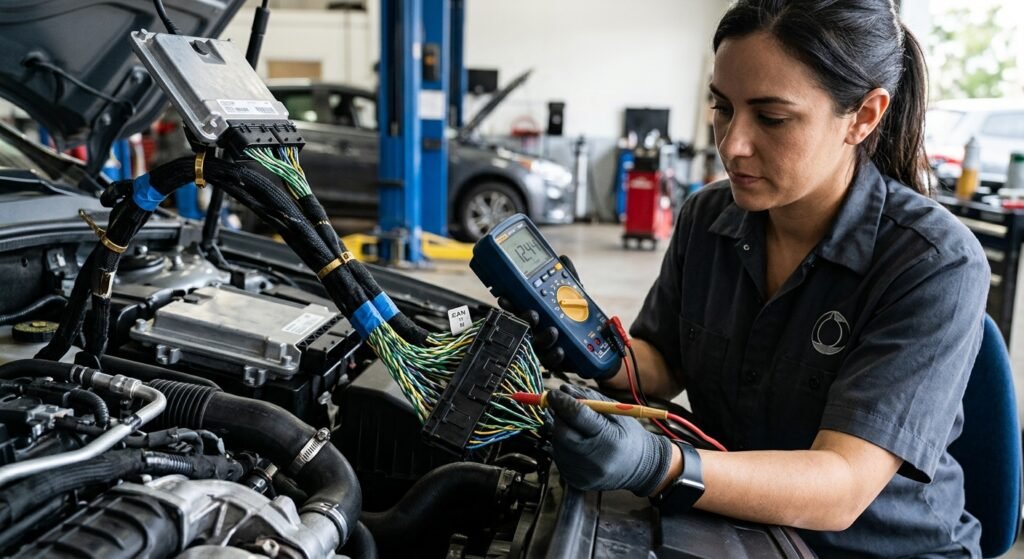
Step-by-step technician diagnosis
Diagnosis follows a methodical path. A competent technician will proceed in this order to avoid unnecessary module swaps:
- Confirm the code and capture freeze-frame data and any concurrent DTCs with a capable scan tool.
- Check battery voltage and charging system (low voltage often causes network timeouts).
- Inspect fuses and relays that feed the BCM and related circuits.
- Visually inspect the BCM connectors, harness, and ground points for corrosion, water intrusion, or damage.
- Use the scan tool to see if the BCM shows up on the network. If the BCM is completely absent, test for power and ground at the module pins (factory wiring diagram helps).
- Measure CAN bus voltages and continuity; look for shorts or open circuits and test for proper termination resistance.
- Check for aftermarket modules or recent work (alarms, remote starters) that might have tapped into the network incorrectly.
- If the BCM is present electrically but not communicating properly, attempt module wake and re-scan; sometimes reflashing or reprogramming will restore proper network IDs and functions.
- Only after wiring, power, and grounds are verified bad-free should a module be replaced or reprogrammed.
Quick reference table: cause, how to test, likely outcome
| Probable Cause | How a tech tests it | Likely Fix |
|---|---|---|
| Low battery/voltage | Battery/tester, charging system check | Charge/replace battery, retest networks |
| Blown fuse/relay | Inspect fuses, test relay sockets | Replace fuse/relay, confirm restore |
| Damaged CAN wiring | Continuity, resistance, wiggle tests, visual inspection | Repair wiring or connectors, secure harness |
| Aftermarket interference | Disconnect aftermarket modules, re-scan | Remove or rewire aftermarket device correctly |
| Unprogrammed or mismatched BCM | Scan tool shows BCM but VIN mismatch or blank calibration | Program BCM to VIN (module programming) |
| Failed BCM | All power/grounds ok, still no comms | Replace BCM and perform module programming |
Common misdiagnoses to avoid
- Replacing the BCM before confirming power, grounds, and wiring — this wastes parts and money.
- Blaming unrelated modules; always document all network DTCs and freeze-frame data first.
- Assuming an aftermarket alarm is isolated — many are not and can load or short the CAN bus.
- Attempting board-level “repair” of a deployed or water-damaged module instead of proper module replacement and programming — manufacturer procedures require replacement and programming when needed.
What the correct fix looks like
After troubleshooting, the correct fix may be:
- Simple wiring, ground, or fuse correction — the fastest outcome.
- Removal of interfering aftermarket equipment.
- Reprogramming or calibration of the existing BCM so it communicates properly on the vehicle network.
- Replacement of the BCM followed by VIN-specific programming and relearns so other modules recognize it.
Module programming and diagnostics should be handled with manufacturer-capable scan tools and a technician who understands vehicle networks. Incorrect programming can cause more communication errors.
How LockNCal helps
For Mitsubishi vehicles showing U0140, LockNCal provides professional on-site module diagnostics and programming services to verify wiring, confirm BCM presence, and perform any necessary module programming. We do not perform bodywork or board-level repairs — we diagnose, reset, program, and replace modules as the manufacturer requires. If a programming step is required, our techs use proper tools and procedures to restore network communication.
FAQ
Q: Can I clear U0140 myself?
A: You can clear the code with a scan tool, but if the root cause is not fixed the code will return. Clearing codes without diagnosing can hide a real problem and is not a long-term solution.
Q: Will replacing the BCM always fix U0140?
A: Not always. Replacing the BCM without verifying power, grounds, and CAN wiring, or without programming the new module to the vehicle, often results in recurring communication faults.
Q: Could an alarm or remote starter cause this code?
A: Yes. Poorly installed aftermarket electronics that tap into data lines or power can cause network faults including U0140. Remove or isolate aftermarket gear as part of the diagnosis.
Q: Is it expensive to fix U0140?
A: Costs vary widely depending on the root cause. Simple fixes like fuses or wiring are inexpensive. Module replacement plus programming costs more. For an accurate estimate, get a diagnostic scan that lists all related DTCs and freeze-frame data.
Q: Can I keep driving with U0140 present?
A: It depends on symptoms. If critical lights or safety systems are affected, don’t drive. If only convenience items are affected you can move the vehicle short distances, but schedule diagnostics quickly.
If you need professional module diagnostics or programming for a Mitsubishi with U0140, our technicians can diagnose the network, check wiring and grounds, and perform module programming when required. Schedule a service appointment online at https://lockncal.com/mobile-module-programming-services/ or call (469) 277-7277 for help.


