 Skip to content

Direct answer: P0740 on a Honda means a Torque Converter Clutch (TCC) circuit malfunction — the transmission control system has detected a problem controlling the lock‑up clutch. Fixing it requires accurate diagnosis (scan data, wiring checks, solenoid tests, fluid/pressure checks) and usually a transmission specialist to repair or replace the faulty component.
Key Takeaways
- P0740 Honda = Torque Converter Clutch Circuit Malfunction (confirmed code meaning).
- Common causes: faulty TCC solenoid, wiring/connectors, low/contaminated fluid, torque converter mechanical failure, or TCM/PCM fault.
- Start with a full OBD2 scan and live data, then check wiring, solenoid resistance, and transmission fluid condition.
- Often requires a transmission shop for pressure tests, solenoid replacement, or torque converter replacement — don’t guess.
What P0740 Means on a Honda
The verified code meaning for P0740 is: Torque Converter Clutch Circuit Malfunction. That tells you the control circuit that activates the torque converter lock‑up clutch is not behaving as expected. The vehicle’s powertrain control module (PCM) or transmission control module (TCM) has detected an electrical or functional fault in the TCC circuit.
Why This Happens — Common Causes
Several different problems can trigger P0740. The most common categories are:
- Electrical: damaged wiring, corroded or loose connectors, open/short in the TCC solenoid circuit, or poor ground.
- Actuator/Component: failed TCC solenoid (stuck open/closed), failed clutch in the torque converter, or stuck valve in the valve body.
- Hydraulic/Fluid: low transmission fluid, severely dirty/contaminated fluid, or internal leaks preventing proper pressure to engage TCC.
- Control module/software: TCM/PCM fault, or software calibration problem (less common).
Typical Symptoms Drivers Notice
- Check Engine Light or Transmission warning lamp illuminated.
- Poor highway fuel economy (TCC not locking up).
- Transmission shudder, hesitation, or slipping at steady speeds.
- Harsh shifting or inability to lock the torque converter on acceleration or cruising.
- Some Hondas (Civic, Accord, Odyssey) may show the code intermittently depending on driving conditions.
Quick Model Notes
Owners commonly search for terms like “p0740 honda civic”, “2001 honda civic p0740”, “honda odyssey p0740 2002”, and “p0740 honda accord” because the failure mode and diagnostic approach are similar across those models. The specific connector locations and TCM behaviour vary by year and transmission model, so confirm wiring diagrams and service data for your exact year/model before replacing parts.
Step-by-step Technician Diagnosis (real tools, correct order)
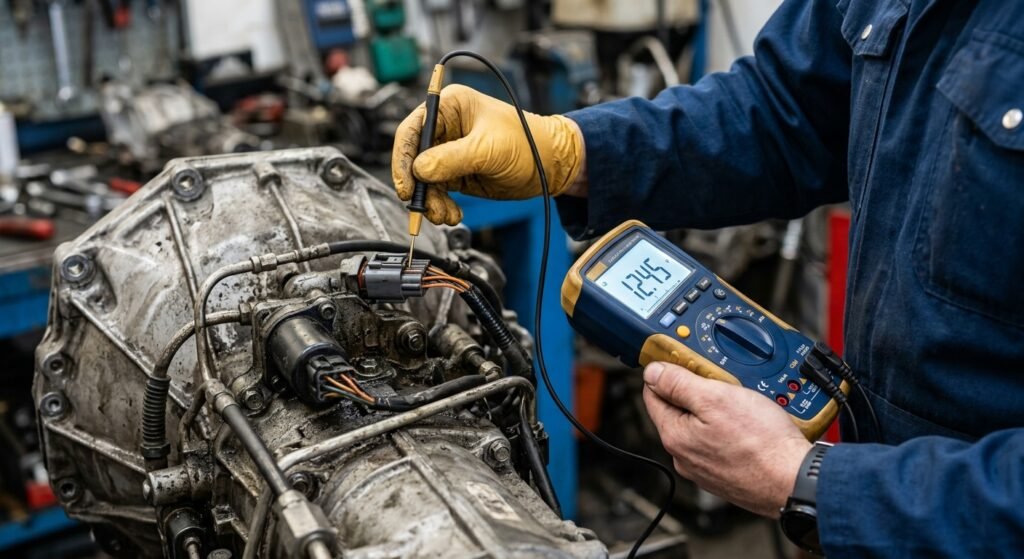
Follow a methodical order — don’t start by replacing the torque converter. Use these tools: OEM or quality OBD2 scan tool with live data, DVOM (digital volt/ohm meter), backprobing leads, transmission fluid pressure gauge (if needed), and a mechanical lift or safe jack stands for access.
- Full scan and freeze frame: Read all codes on both PCM and TCM. Capture live data and freeze frame to know RPM, speed, load, and fluid temperature when the code set.
- Live data check: Watch TCC command vs. TCC duty or solenoid status. If the PCM commands lock but the actual status or line pressure doesn’t follow, you have either electrical or hydraulic failure.
- Inspect fluid & level: Check transmission fluid level, color and smell. Low or burned fluid can cause solenoids to stick and poor engagement.
- Wiring and connector inspection: Visually inspect harnesses to transmission, TCC solenoid connector, and grounds. Wiggle test while watching live data for intermittent faults.
- Solenoid resistance/voltage test: With ignition on (engine off) or backprobing during operation (follow safe manufacturer procedure), measure solenoid coil resistance and voltage when commanded. Compare to factory spec.
- Pressure and mechanical tests: If electrical checks pass, a transmission pressure test and valve body inspection may be next. A failing torque converter will often require removal for bench testing or replacement.
- TCM/PCM updates: Confirm whether any TCM/PCM software updates are available — in rare cases a reflash can fix false codes, but only after excluding electrical/hydraulic causes.
Diagnosis & Repair Actions — Table
| Probable Cause | What to Check First | Typical Professional Action |
|---|---|---|
| Faulty TCC solenoid | Solenoid resistance, apply power, watch live data | Replace solenoid or valve body, bench-test torque converter if needed |
| Wiring or connector fault | Inspect harness, backprobe for voltage/ground, wiggle test | Repair/replace damaged wiring or connector, secure grounds |
| Low/contaminated fluid | Check level, color, smell; filter condition | Fluid & filter service; if severe damage, further internal inspection |
| Torque converter internal failure | Pressure test, stall test, bench test after removal | Torque converter replacement and/or transmission overhaul |
| TCM/PCM software or module fault | Confirm diagnostics, attempt reflash if manufacturer bulletin exists | Reflash or replace module (rare for P0740 once electrical/hydraulic checked) |
When Is It Safe to Drive?
If the code is active and you notice slipping, shudder, or loss of drive, do not drive long distances — you may cause further transmission damage. If the vehicle runs and shifts normally and the only symptom is a check engine light with the code stored, short local driving to a trusted shop for diagnosis is typically safe. Err on the side of caution: if the transmission behaves oddly, have it checked immediately.
Common Missteps to Avoid
- Replacing the torque converter or transmission without confirming electrical and wiring integrity first.
- Replacing fluid without addressing a shorted or open solenoid circuit — the code may return.
- Assuming a one‑size‑fits‑all fix — the exact failure path differs between a 2001 Civic, a 2002 Odyssey, and newer Accords.
Costs & Who Should Fix It
Because P0740 may reflect an electrical, hydraulic, or mechanical issue, the cost ranges widely depending on the root cause. Electrical fixes or solenoid replacements are usually less expensive than torque converter replacement or a transmission rebuild. For accurate pricing get a clear diagnosis and shop estimate from a reputable transmission specialist or dealer.
Next Steps for Honda Owners
- Get a full OBD2 scan with live data (confirm both PCM and TCM). Many independents and dealerships will perform this.
- Ask the technician to follow the diagnostic order above (scan → wiring → solenoid → pressure/tests).
- If you’re buying a used Honda and see this code, request a specialist inspection or a pre-purchase vehicle inspection before completing the purchase.
If you need a trustworthy inspection before buying or driving a vehicle with a stored P0740, consider a professional pre-purchase check: mobile pre-purchase vehicle inspection. To arrange a local diagnostic appointment or scan, you can schedule an appointment.
Note: LockNCal specializes in vehicle safety and security systems (airbags, SRS modules, ADAS calibration, and keys). P0740 is a transmission code and is best handled by a transmission specialist or dealer.
FAQ
Q: What exactly does P0740 mean on my Honda?
A: P0740 means Torque Converter Clutch Circuit Malfunction — the control circuit for the torque converter lock‑up clutch is reporting a fault.
Q: Can I clear the code myself?
A: You can clear the code with an OBD2 scanner, but clearing it does not fix the underlying issue. If the problem remains, the code will likely return and you risk further transmission damage.
Q: Is P0740 serious on a Honda Odyssey or Civic?
A: It can be. If it causes slipping, shuddering, or loss of drive, it’s serious and should be diagnosed promptly. On some vehicles it may be an intermittent electrical fault, but don’t ignore it.
Q: Will changing the transmission fluid fix P0740?
A: If low or contaminated fluid caused the solenoid to stick or prevented proper pressure, a fluid and filter service can help — but only after confirming electrical and mechanical checks. Fluid change alone won’t fix a failed solenoid or torque converter.
Q: I have P0740 on a 2001 Honda Civic — can I still drive it?
A: Short local trips may be okay if the transmission feels normal, but avoid long highway driving. If you notice slipping or odd behavior, stop driving and have it checked.
Need a professional scan or to schedule an inspection? Book an appointment for a diagnostic or pre-purchase inspection here: Schedule an appointment, or call (469) 277-7277. LockNCal handles the vehicle’s safety & security systems (airbags/SRS, ADAS, keys) if you ever need those services.


