 Skip to content

Lexus B0001 Airbag Code — Causes, Symptoms & Fix
Direct answer: Lexus B0001 is the manufacturer-defined code for Driver Frontal Stage 1 Deployment Control – a fault in the driver airbag deployment circuit. It means the SRS system has detected a problem in the driver airbag squib/deployment path; the correct fix depends on diagnosis and can range from connector/wiring replacement or clock-spring replacement to SRS module reset or module programming.
Not near Dallas–Fort Worth? Mail us your airbag / SRS module.
We reset most airbag control modules by mail — free 2-way shipping and a fast turnaround. We clear the crash data, restore factory settings, and ship it right back, anywhere in the U.S.
Key Takeaways
- B0001 = Driver Frontal Stage 1 Deployment Control — a fault in the driver airbag deployment circuit.
- Scan first with an SRS-capable tool, then inspect connectors, steering column clock spring, and squib wiring.
- If wiring or components are bad replace the airbag, clock spring, or connectors; if the module has logged crash data or an internal fault, the SRS module may need reset or programming.
- Driving with this code can mean the driver airbag may not deploy — address it promptly and safely.
What Lexus B0001 actually means
The verified definition: Driver Frontal Stage 1 Deployment Control – a fault in the driver airbag deployment circuit. In plain English: the vehicle’s Supplemental Restraint System (SRS) detected a problem in the electrical path that fires the driver’s frontal airbag during a Stage 1 deployment event. The SRS control module sets code B0001 when it sees open circuits, short circuits, unexpected resistance, or an internal module condition that would prevent proper deployment.
Common causes
- Loose, corroded, or disconnected airbag (squib) connectors — often the yellow, keyed connectors in the steering column or under the driver seat.
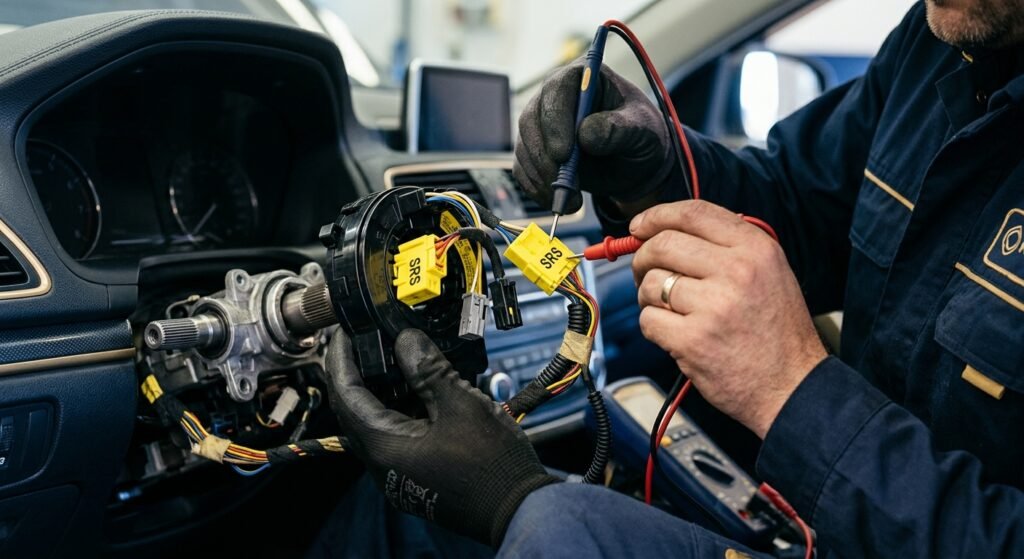
- Damaged steering-column clock spring (spiral cable) — broken ribbon conductors interrupt the squib circuit when the wheel is turned.
- Cut, pinched, or chafed wiring in the steering column or between the airbag and SRS control module.
- Faulty driver airbag module (the squib itself) or a connector that’s pushed out of spec.
- SRS control module internal fault or crash data stored after a deployment — requires reset or reprogramming.
Symptoms you’ll notice
- Airbag warning light illuminated on the dash (steady light, usually at ignition on).
- Possible supplementary warnings on the instrument cluster saying “Airbag” or “SRS”.
- Less common: intermittent airbag light that comes back after clearing codes, or a light that appears after steering wheel movement.
- After a collision, the light may remain on because the module recorded deployment data.
Tools and safety essentials before you start
- SRS-capable OBD-II scan tool that shows freeze frame and SRS fault location.
- Digital multimeter for low-resistance continuity checks.
- Basic hand tools to access connectors and the steering column.
- Manufacturer SRS safety procedure: disconnect the battery and follow the recommended wait time before touching airbag circuits to avoid accidental deployment. If unsure, have a trained technician do the work.
Step-by-step diagnostic order (recommended)
- Read the code and freeze frame: Use an SRS-capable scanner to confirm B0001 and capture freeze-frame data — this tells you conditions when the fault set (ignition state, speed, events).
- Visual inspection: Look for damaged wiring, pushed or corroded yellow airbag connectors at the steering column and under the seats (if seat related). Check the driver airbag pad for signs of previous work or damage.
- Check the clock spring: If the light appears with wheel movement or the steering wheel has been removed/replaced, the clock spring is a frequent cause. Inspect for binding, unusual resistance, or noise.
- Continuity/resistance checks: With the battery disconnected and following safety wait times, measure continuity of the driver squib circuit at both the airbag connector and at the SRS control module connector. You’re checking for opens or shorts to ground. Keep wires disconnected from both ends when measuring and document values.
- Connector wiggle test: With the system safe to power, an experienced technician can wiggle connectors and the steering column while watching live data on the scanner to see if the fault triggers.
- Isolate replaced parts: If wiring and connectors are OK and clock spring checks out, the driver airbag assembly (squib) itself can be the issue — replacing the airbag assembly is the correct fix for a failed squib.
- Module check: If all harness, connectors, and components test normal, the SRS control module may have an internal fault or stored crash data. That requires module reset or reprogramming/diagnostics by a trained service.
How the correct fix is chosen
The repair (replacement) path depends on which component failed tests:
- Open or intermittent circuit in steering column → replace clock spring (spiral cable).
- Damaged or corroded connector/wiring → replace or properly terminate connectors and harness sections (do not use generic repair kits that splice webbing or pretend to restore a fired pretensioner).
- Failed driver airbag squib → replace the airbag module (the squib is single-use pyrotechnic from the factory).
- SRS control module shows crash data or internal error → module reset or programming may be required; this is where a professional SRS services specialist is appropriate.
Quick reference table: cause, test, likely fix
| Suspected cause | Test to run | Likely service |
|---|---|---|
| Open/short in squib wiring | Continuity & insulation test with multimeter (battery disconnected) | Replace wiring section or connector; verify with scan |
| Clock spring failure | Resistance/continuity across steering wheel circuits; live-scan wiggle test | Replace clock spring (spiral cable) |
| Faulty driver airbag (squib) | Resistance at airbag connector; comparison with spec or replacement check | Replace airbag module |
| SRS control module internal fault or crash data | Scan shows stored crash data or internal module faults | Module reset or module programming / replacement |
When is it safe to drive?
With B0001 present the driver airbag deployment path is suspect. That means the driver airbag might not deploy in a crash, or it could behave unpredictably. If possible, avoid driving the vehicle until the fault is diagnosed and corrected. If you must drive, keep speeds low, avoid long trips, and have the issue addressed as soon as practical. For vehicles recently in a collision, do not drive—have them towed and inspected.
How LockNCal helps
LockNCal offers SRS airbag module reset and programming (nationwide mail-in and mobile in DFW) and on-site vehicle safety system services. If diagnostics show the SRS control module needs a reset or programming, we provide a secure mail-in SRS airbag module reset service or mobile module work where available. See our mail-in airbag module reset for nationwide options and our vehicle safety system services page for the full list of on-site services including clock spring and airbag module replacement assistance.
Practical tips & common mistakes
- Don’t let anyone sell you a “repair kit” that promises to make a fired pretensioner or squib safe again — these are single-use and must be replaced.
- Always use an SRS-capable scanner; generic code readers often miss freeze-frame and live-data needed for proper diagnosis.
- Document tests and keep connectors clean and secure—corrosion under a yellow connector is a surprisingly common failure cause.
- If you’re uncomfortable working around airbags, stop. Airbags are pyrotechnic devices; incorrect handling can be dangerous.
FAQ
What does Lexus B0001 mean?
B0001 stands for Driver Frontal Stage 1 Deployment Control – a fault in the driver airbag deployment circuit. It indicates the SRS detected a problem that could prevent the driver airbag from firing properly.
Can I clear the B0001 code myself?
You can clear the code with an SRS-capable scanner, but if the underlying electrical fault remains the code will return. Always diagnose the root cause before clearing codes—clearing without fixing can give a false sense of safety.
How much does it cost to fix?
Costs vary widely by the failed component and your vehicle. If the SRS control module only needs a reset, our nationwide mail-in airbag module reset is a flat service option. For a tailored price for on-site work, use the booking form to see exact pricing and options.
Is it safe to drive with the airbag light on?
Driving with the airbag light on is not recommended because the driver airbag may not deploy in a crash. Minimize driving and have the system diagnosed quickly.
Who should do the diagnosis and fix?
An experienced technician with SRS tools should perform the diagnosis. If the SRS module requires resetting or programming, use a specialist. LockNCal provides module reset and programming services and mobile support in our service area.
If you suspect B0001 on a Lexus, start with a proper SRS scan and then follow the diagnostic order above. For module-level work or a fast mail-in reset, see our mail-in option at mail-in airbag module reset or schedule a full safety system inspection at Schedule an appointment. Call (469) 277-7277 for help or to discuss options.


