 Skip to content

Airbag Module Water Damage — Symptoms, Risks & Fixes
Direct answer: Water inside an SRS/airbag module can corrode circuit boards, short connectors and corrupt crash data, causing the airbag light and unsafe restraint behavior. The safe route is professional diagnostics, module programming or replacement — for many modules a certified reset or reprogramming restores service; some flooded modules must be replaced.
Not near Dallas–Fort Worth? Mail us your airbag / SRS module.
We reset most airbag control modules by mail — free 2-way shipping and a fast turnaround. We clear the crash data, restore factory settings, and ship it right back, anywhere in the U.S.
Key Takeaways
- Water intrusion can permanently damage an airbag (SRS) module’s electronics and stored crash data.
- Visible moisture or a persistent airbag light means don’t ignore it — the vehicle may be unsafe in a crash.
- After drying, a scan is needed to read DTCs and determine if reset, reprogramming, or replacement is required.
- DIY “repair kits” are not manufacturer-approved; trust diagnostics and reset or replacement from qualified providers.
- LockNCal offers nationwide mail-in SRS airbag module reset plus mobile services in DFW for module programming and replacement support.
How water damages an airbag (SRS) module
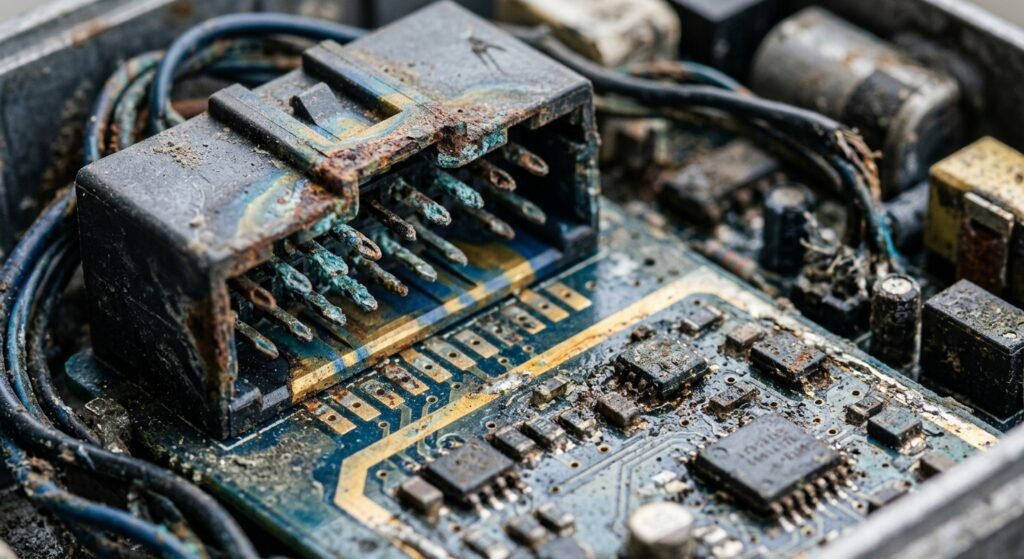
The SRS module is an electronic control unit with a printed circuit board (PCB), microcontroller, flash memory (which stores crash event data) and connectors to airbag and sensor circuits. Water and salt accelerate corrosion, bridge conductor paths, and can physically damage the flash memory that records crash events. Short circuits or corroded traces can cause permanent failures or intermittent faults that make the airbag system unreliable.
Common entry points for moisture
- Cabin leaks (sunroof seals, door seals, windshield leaks) allowing water onto the dash where the module sits.
- Flooding or high-water events that submerge the interior, exposing the module to standing water.
- Condensation in vehicles stored in damp conditions for long periods.
Symptoms that suggest water damage to the SRS module
- Persistent airbag or SRS warning light on the dash.
- Multiple airbag-related DTCs (communication faults, memory errors, sensor short-to-ground).
- Intermittent faults: light goes off then returns after driving or after hitting bumps.
- Visible corrosion or moisture around the module or connector pins when inspected (never probe without proper precautions).
What a technician does to diagnose water damage
- Start with a full OBD-II scan using a trusted SRS-capable scanner to capture DTCs and freeze frame data.
- Visually inspect module connectors, harnesses and grounds for corrosion or green/white deposits.
- Check continuity and insulation resistance of SRS wiring where accessible; measure voltages at key connectors per factory procedure.
- If the module was exposed to water, the tech will determine whether the flash memory and microcontroller respond and whether crash data can be read or is corrupt.
- Decide whether the fault is fixable by cleaning and reset/programming or whether module replacement is required (or seat belt/airbag replacement if pyrotechnics deployed).
Why “repair kits” and casual fixes are risky
Online kits and DIY attempts to “fix” a soggy SRS module often involve cleaning boards, reflowing solder, or replacing individual components. These are not manufacturer-approved for safety-critical restraint systems. A module that looks functional after a DIY fix can still have degraded memory, hidden corrosion or undetectable timing faults that prevent airbags and pretensioners from deploying correctly in a crash. The safe, correct paths are reset/programming by a qualified service or full replacement when required.
Which outcomes are possible after water exposure?
There are three typical outcomes after a professional inspection:
- Module safe to reset/program: flash memory intact and connectors recoverable — the module can be cleared and returned to service after verification.
- Module repair is unsafe: corrosion or memory corruption means the module must be replaced to ensure reliable restraint function.
- Peripheral component replacement is needed: seat belt pretensioners, airbag inflators, occupant detection modules or clock springs may be damaged and require replacement.
Quick reference: symptoms, likely cause, recommended action
| Symptom | Likely cause | Recommended action |
|---|---|---|
| Airbag light steady on | Stored DTC(s) in SRS module; possible connector corrosion | Scan for codes; inspect connectors; professional reset/program or replacement |
| Intermittent light | Intermittent contact from corrosion or dampness | Drying, full diagnostic, harness cleaning and testing; likely module reset if memory intact |
| Corrosion visible on pins | Electrochemical damage to connectors and PCB traces | Do not power-cycle repeatedly; get a pro inspection—module may need replacement |
| Vehicle was submerged | High risk of permanent module or sensor damage | Assume replacement of pyrotechnic parts; scan and test module—some modules can still be reset but many cannot |
What LockNCal specifically does
LockNCal does not perform board-level repairs or DIY fixes. Instead we offer professional diagnostics, programming, replacement services coordination, and our flagship nationwide mail-in SRS airbag module reset. If your SRS module can be safely reset, our mail-in service can often clear crash data and restore the module to service quickly and affordably. For customers in the Dallas–Fort Worth area we also provide mobile airbag module reset and on-site services to inspect connectors and program replacements.
LockNCal’s nationwide mail-in reset includes free two-way shipping, and most modules ship back within about 24 business hours — you’ll see your exact price in about 60 seconds when you book online. We include free two-way shipping and most modules return within about 24 business hours after receipt — use the mail-in option when you cannot get to a local specialist.
When is it safe to drive?
If the airbag light is on, the restraint system may not work correctly. Short, local trips at low speeds might seem fine, but the risk in any crash is unpredictable. If you must move the vehicle a short distance to a safe location or repair shop, do so carefully. Otherwise, schedule a diagnostic or use a tow. Don’t postpone inspection—airbag and pretensioner faults are safety-critical.
Preventing water damage to SRS modules
- Fix known leaks immediately—sunroof, windshield and door seals are common culprits.
- Avoid driving through deep water and don’t leave the vehicle submerged after floods.
- Dry and ventilate vehicles stored in humid environments; remove carpet and padding if interior stays wet.
- After any flood exposure, get a professional safety-system inspection before relying on airbags and seat belts.
FAQ
Can a wet airbag module be cleaned and reused?
Sometimes. Surface corrosion and dampness can occasionally be resolved and the module safely reset, but if flash memory or PCB traces are damaged the module must be replaced. A professional scan and inspection are required to decide.
Are DIY “airbag module repair kits” safe?
No. Kits that claim to “repair” SRS modules are not manufacturer-approved for safety-critical systems. They can leave hidden faults that prevent proper airbag deployment. Use a qualified reset or replace the module.
How much does a mail-in reset cost?
LockNCal’s nationwide mail-in reset includes free two-way shipping, and most modules ship back within about 24 business hours — you’ll see your exact price in about 60 seconds when you book online. Two-way shipping is free and most modules are back within about 24 business hours after we receive them.
Can flood-damaged airbags or seat belts be fixed?
No. Deployed or water-damaged pyrotechnic devices (airbag inflators, pretensioners) must be replaced. LockNCal performs module resets, programming and coordinates replacements but does not recondition pyrotechnic parts.
What should I do right now if I suspect water damage?
Don’t ignore a persistent airbag light. Get an SRS-capable diagnostic scan and visual inspection of the module and connectors. If you’re outside DFW, consider our nationwide mail-in SRS module reset: mail-in airbag module reset. If you’re in DFW, schedule a mobile inspection.
For professional help, diagnostics, and safe module resets, learn about our nationwide mail-in airbag module reset or our broader vehicle safety system services. To book service or get a quote, call (469) 277-7277 or schedule online.
Mail-in airbag module reset — fast, inspected, and returned; call (469) 277-7277 to discuss your situation.


