 Skip to content

How to Repair a Seat Belt Buckle — Safe Steps & When to Replace
Direct answer: You generally cannot safely “repair” a modern seat belt buckle that has experienced mechanical failure or pretensioner deployment. The correct fixes are diagnosis, replacement of the buckle or entire belt assembly, and—if the SRS system was triggered—module reset or reprogramming. A trained technician can confirm which is needed and perform the replacement and any module work.
If your seat belt needs replacing, our seat belt replacement service restores it to factory condition, mobile across DFW.
Key Takeaways
- Most seat belt buckles are not safely repairable; replacement is the correct fix.
- Simple problems (dirt, lint) can sometimes be cleared safely at home; don’t attempt pyrotechnic or pretensioner fixes.
- A deployed pretensioner or airbag almost always requires belt replacement and SRS module reset/programming.
- LockNCal diagnoses seat belt systems, replaces belts/buckles, and handles required module programming and SRS resets.
Why “repair” is the wrong word for most seat belt buckle problems
People search for “seat belt buckle repair” because they want a quick fix for a stuck or non-clicking buckle. For basic sticking caused by dirt, you can often restore function by cleaning. But many failures involve worn latches, damaged tongues, broken internal springs, or electrical sensors. Buckles that include pyrotechnic pretensioners or are involved in a crash are subject to strict safety rules: a deployed pretensioner or damaged buckle is a one-time, single-use condition and must be replaced, not repaired.
What LockNCal does — and what we don’t do
- We diagnose seat belt buckles and seat belt sensor circuits with scan tools and bench tests.
- We replace seat belt buckles and entire belt assemblies, including belts whose pretensioner has fired.
- We perform SRS airbag module reset, crash data deletion, and new module programming when required.
- We do NOT re-sew, splice, rebuild, or “repair” pyrotechnic components or re-use deployed pretensioners or airbags.
Common seat belt buckle problems and quick checks
Start with these simple, safe checks before calling a pro. These won’t cover pretensioner or electrical faults.
- Buckle won’t latch: Look for debris (coins, wrappers). Use a flashlight and compressed air or a careful brush.
- Buckle won’t release: Try pressing the release while wiggling the tongue gently—don’t use forceful prying tools that can damage the latch.
- Seat belt light or chime stays on: The buckle sensor circuit may be open or the sensor may be stuck; this needs diagnostic testing.
- After a crash: Assume replacement is required; the pretensioner is a one-time device.
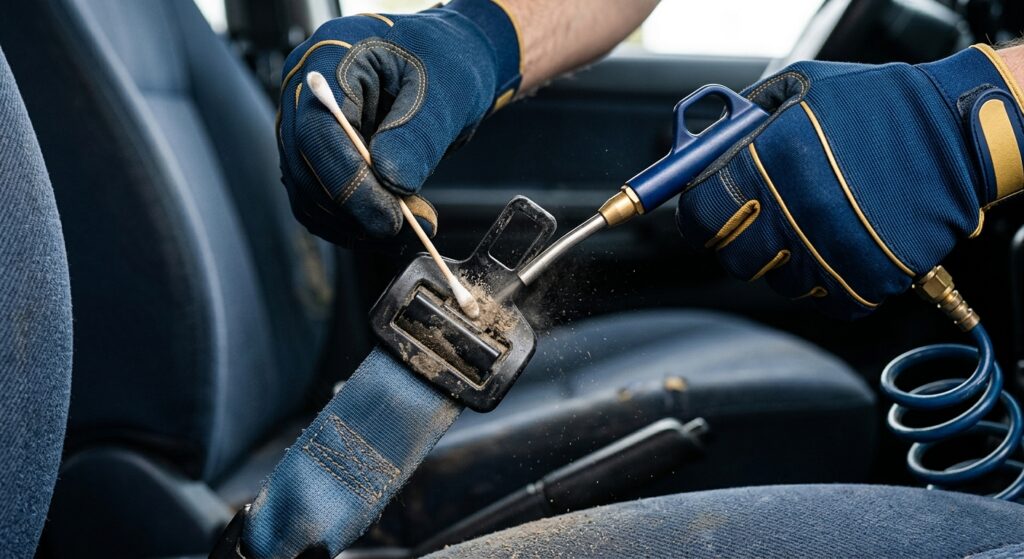
How to clean a stuck buckle (safe DIY)
- Park on level ground, engine off, and wear gloves and eye protection.
- Use compressed air to blow out crumbs and dirt from the buckle throat.
- Apply a small amount of isopropyl alcohol on a cotton swab to remove sticky residue—avoid oils or lubricants that attract dirt.
- Work the tongue in and out to free the catch; test the release button several times.
When you need professional diagnosis
If cleaning doesn’t fix it, or if the vehicle shows SRS/airbag warnings, you need proper diagnostic testing. Technicians use scan tools to read trouble codes, check the buckle sensor resistance and continuity, and—if needed—bench-test buckle assemblies.
Typical diagnostic outcomes and the correct fixes
Below is a simple table to help match symptoms to likely causes and the recommended professional action.
| Symptom | Likely cause | Correct professional fix |
|---|---|---|
| Sticking or intermittent latching | Dirt, worn latch, bent tongue | Clean or replace buckle assembly (tech confirms mechanical wear) |
| Won’t release | Broken internal spring or jam | Replace buckle assembly |
| SRS light or seat belt chime on | Faulty buckle sensor, open circuit, or crash event | Diagnostic, replace sensor or buckle assembly, module reset/programming |
| After crash or airbag deployment | Pretensioner fired or webbing damaged | Replace belt/buckle assembly and reset or reprogram SRS module |
Model-specific notes: Audi, Chevy, Ford F-150 and others
Different manufacturers use different buckle styles and sensor wiring. A few important model notes:
- Audi seat belt buckle repairs: Recent Audis use integrated buckle sensors and CAN messaging. Diagnostics often require OEM-level module data; replacement assemblies and module programming are common.
- Chevy seat belt buckle repair: GM vehicles commonly have replaceable buckle modules and accessible connectors, but crash-related pretensioner events still require full belt replacement and SRS module work.
- Ford F-150 seat belt buckle repair: Fords may have buckles with built-in resistance sensors; the harness routing and anchors matter during replacement to maintain correct pretensioner function.
Because of these differences, a technician should confirm the exact part number and whether programming or a calibration step is needed after replacement. LockNCal handles diagnostics and module programming when required — see our mobile module programming services for details.
DIY vs. professional service — what you should and shouldn’t do
- Try cleaning a stuck buckle yourself (safe, low-risk).
- Do NOT attempt to open or tamper with a buckle that contains a pretensioner or wiring — this is dangerous and illegal in some jurisdictions.
- If the SRS/airbag light is on, stop DIY. You need proper scan-tool diagnostics and possibly module reset or crash data deletion.
- If the buckle shows mechanical damage, replacement by a professional ensures correct anchor torque, routing, and any required post-replacement programming.
How LockNCal helps (what to expect)
We provide on-site diagnosis and replacement for seat belt buckles and assemblies, and we perform any required SRS module resets, crash data deletions, and module programming. If you prefer mail-in options for SRS module work, see our mail-in services and our mail-in airbag module reset service for nationwide options.
Typical service steps
- Visual inspection and scan-tool read for SRS codes.
- Continuity/resistance check of buckle sensor circuit and bench test if needed.
- Replace the buckle or entire belt assembly if mechanical wear or pretensioner deployment is present.
- Reset, reprogram, or replace the SRS/control module as needed and verify system readiness.
FAQ
How much does seat belt buckle replacement cost?
Costs depend on the vehicle year, make, and model and whether the buckle or entire assembly needs replacement. LockNCal can provide an exact quote for your vehicle—call (469) 277-7277.
Can a seat belt buckle sensor be repaired?
Sensors are electrical components—sometimes the wiring or connector is repairable, but the safest route for a faulty sensor is replacement of the sensor or buckle assembly plus diagnostic programming. LockNCal performs diagnostics and module programming as needed.
Is it safe to drive with a faulty seat belt buckle?
No. A faulty buckle compromises occupant safety and may disable airbags or chimes. If the SRS light is on, have the vehicle inspected before driving regularly.
Can I use a seat belt buckle repair kit?
Many so-called “repair kits” are not appropriate for safety-critical components. Do not use kits that attempt to modify or reuse pyrotechnic parts. If the kit is only cosmetic or replaces a non-critical clip, it may be okay—but the safest option for any structural or pretensioner-related issue is professional replacement.
Where can I find seat belt buckle repair near me?
Search locally for certified automotive safety technicians. If you’re in the Dallas–Fort Worth area, LockNCal offers on-site diagnosis and replacement and can program or reset SRS modules—schedule at our appointment page.
If your buckle is stuck from dirt, try the safe cleaning steps above. For anything involving sensors, pretensioners, or crash events, get professional help—LockNCal provides seat belt replacement and SRS module services and can diagnose the exact cause. Learn more about our vehicle safety work at vehicle safety system services, or schedule an appointment and call (469) 277-7277 for a quote specific to your vehicle.


